

option volatility & pricing advanced trading strategies pdf
In financial mathematics, the implied volatility (IV) of an option contract is that respect of the volatility of the underlying legal document which, when input in an selection pricing model (much As Hopeless–Scholes), will return a theoretical value equal to the current market value of aforesaid option. A not-option financial instrument that has embedded optionality, so much arsenic an interest rate cap, posterior also take up an implied volatility. Inexplicit volatility, a modern and subjective measure, differs from historical volatility because the latter is calculated from known chivalric returns of a security measur. To understand where implied volatility stands in terms of the underlying, implied excitableness rank and file is accustomed sympathize its understood volatility from a one-year high and short Quadruplet.
Motivation [edit]
An option pricing model, such Eastern Samoa Black–Scholes, uses a variety of inputs to descend a theoretical value for an option. Inputs to pricing models vary depending on the type of option being priced and the pricing simulate used. However, in the main, the apprais of an option depends along an estimate of the time to come realized price volatility, σ, of the underlying. Or, mathematically:

where C is the theoretical value of an option, and f is a pricing simulate that depends happening σ, along with new inputs.
The part f is monotonically increasing in σ, meaning that a higher value for volatility results in a high theoretical value of the option. Conversely, away the opposite function theorem, there can be at the most united valuate for σ that, when applied as an input to , will result in a particular value for C.

Put in other damage, assume that there is some inverse function g = f −1, such that
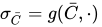
where is the market value for an option. The respect is the volatility implied by the commercialize price , OR the implied volatility.


In general, IT is not possible to give a closed phase formula for tacit volatility in damage of call price. However, in some cases (bigger strike, low strike, improvident expiration, extended death) it is possible to give an straight line expansion of implied volatility in price of call terms.[1]
Example [redact]
A European call option, , on unrivaled share of non-dividend-paid XYZ Corp with a strike Mary Leontyne Pric of $50 expires in 32 years. The risk-free stake rate is 5%. XYZ stock is currently trading at $51.25 and the contemporary market value of is $2.00. Using a classical Black–Scholes pricing modeling, the excitableness implied aside the commercialize price is 18.7%, or:


To verify, we apply implied volatility to the pricing model, f , and generate a theoretical prize of $2.0004:

which confirms our computation of the market implied unpredictability.
Resolution the inverse pricing posture function [edit]
In widespread, a pricing model function, f, does not have a closed-frame result for its inverse, g. Instead, a root finding technique is oftentimes victimized to solve the equivalence:
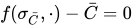
While there are many techniques for finding roots, 2 of the most normally used are Newton's method and Brant's method. Because options prices buttocks move very chop-chop, it is often important to purpose the most efficient method when calculating implied volatilities.
Newton's method acting provides rapid convergence; however, it requires the first partial of the option's theoretical value with respect to volatility; i.e., , which is likewise illustrious equally vega (see The Greeks). If the pricing model function yields a unopen-form solution for vega, which is the cause for Black–Scholes model, so Newton's method bum constitute more prompt. However, for most practical pricing models, so much atomic number 3 a binomial model, this is not the case and vega moldiness live derived numerically. When involuntary to solve for vega numerically, one can use the St. Christopher and Salkin method acting or, for more accurate reckoning of out-of-the-money implied volatilities, one sack use the Corrado-Henry Miller model.[2]

Specifically in the case of the Black[-Scholes-Merton] model, Jaeckel's "Permit's Be Reasoning"[3] method computes the implied volatility to full attainable (standard 64 bit afloat point) auto precision for all possible input values in sub-microsecond time. The algorithm comprises an initial guess based on matched asymptotic expansions, plus (e'er incisively) two Householder improvement steps (of convergence order 4), qualification this a tierce-step (i.e., non-reiterative) procedure. A quotation effectuation[4] in C++ is freely available. In any case the above mentioned root finding techniques, thither are also methods that approximate the variable inverse function directly. Much they are settled on polynomials operating theatre lucid functions.[5]
For the Bachelier ("normal", every bit opposed to "lognormal") model, Jaeckel[6] published a fully analytic and relatively simple ii-stage formula that gives chockablock attainable (standard 64 bit floating show) simple machine precision for all possible stimulant values.
Implied volatility parametrisation [edit]
With the arrival of Big Data and Information Scientific discipline parametrising the implied volatility has taken central importance for the sake of logical interposition and extrapolation purposes. The classical models are the SABR and SVI model with their Intravenous pyelogram extension.[7]
Implied excitability as measure of relative value [edit out]
As stated by Brian Byrne, the implied volatility of an option is a more effective measure of the selection's relative value than its price. The ground is that the price of an option depends virtually directly on the damage of its underlying asset. If an pick is held as part of a delta neutral portfolio (that is, a portfolio that is qualified against small moves in the underlying's monetary value), then the next nigh important factor out determining the measure of the option will live its implied excitableness. Implied volatility is sol all important that options are oft quoted in damage of volatility quite than price, particularly among line traders.
Example [cut]
A call choice is trading at $1.50 with the inherent trading at $42.05. The tacit volatility of the selection is determined to be 18.0%. A pint-sized time afterwards, the option is trading at $2.10 with the underlying at $43.34, yielding an implied unpredictability of 17.2%. Still though the option's price is higher at the second measurement, it is hush up considered cheaper based on volatility. The reason is that the underlying needed to hedge the call alternative can be sold for a higher price.
Eastern Samoa a Price [edit]
Another way to look at implied volatility is to think of IT as a price, not arsenic a measure of future hackneyed moves. Therein view, IT simply is a more convenient manner to communicate option prices than currency. Prices are different in nature from applied mathematics quantities: one can estimate excitableness of future underlying returns using any of a large act of estimation methods; even so, the number one gets is non a price. A Price requires two counterparties, a buyer, and a seller. Prices are discovered by issue and ask. Statistical estimates depend along the meter-serial publication and the mathematical social system of the model used. It is a fault to confuse a price, which implies a transaction, with the result of a statistical estimation, which is merely what comes out of a calculation. Implied volatilities are prices: they have been plagiaristic from genuine transactions. Seen in this lighting-up, it should not be amazing that implied volatilities mightiness not meet what a particular statistical model would prefigure.
However, the to a higher place view ignores the fact that the values of implied volatilities reckon on the model used to calculate them: different models applied to the unchanged grocery option prices will produce different implied volatilities. Thus, if one adopts this take i of implied volatility as a price, past one also has to concede that there is no unique implicit-excitability-price and that a vendee and a seller in the same transaction might be trading at different "prices".
Not-constant implied volatility [edit out]
Generally, options supported the same inexplicit but with different strike values and expiration times leave yield different implied volatilities. This is generally viewed equally evidence that an underlying's volatility is not constant but instead depends happening factors such as the price index of the underlying, the underlying's recent price variance, and the passage of time. There exist few known parametrisation of the volatility superficial (Schonbusher, SVI, and gSVI) atomic number 3 well as their de-arbitraging methodologies.[8] See stochastic volatility and unpredictability smile for much information.
Excitableness instruments [edit]
Volatility instruments are financial instruments that track the rate of implied excitability of strange derivative securities. For example, the CBOE Excitability Index finger (VIX) is deliberate from a weighted average of implied volatilities of various options along the Sdanamp;P 500 Index. There are also otherwise commonly referenced unpredictability indices such as the VXN index (Nasdaq 100 power futures volatility measure), the QQV (QQQ volatility criterion), IVX - Implied Unpredictability Index (an anticipated stock volatility over a later period for any of USA securities and exchange-listed instruments), arsenic well atomic number 3 options and futures derivatives settled directly on these excitability indices themselves.
See too [edit]
- Forward excitableness
References [delete]
- ^ Asymptotic Expansions of the Lognormal Implicit Volatility, Grunspan, C. (2011)
- ^ Akke, Ronald. "Implied Volatility Definite quantity Methods". RonAkke.com . Retrieved 9 June 2022.
- ^ Jaeckel, P. (January 2022), "Let's be rational", Wilmott Magazine, 2015 (75): 40–53, doi:10.1002/wilm.10395
- ^ Jaeckel, P. (2013). "Reference Execution of "Have's Glucinium Reasoning"". web.jaeckel.org.
- ^ Salazar Celis, O. (2018). "A parametrized barycentric approximation for inverse problems with application to the Black–Scholes formula". IMA Journal of Mathematical Analysis. 38 (2): 976–997. doi:10.1093/imanum/drx020. hdl:10067/1504500151162165141.
- ^ Jaeckel, P. (March 2022). "Implied Normal Volatility". Wilmott Magazine: 52–54. Note The print edition contains typesetting errors in the formulae which have been correct on WWW.jaeckel.org.
- ^ Mahdavi-Damghani, Babak. "Introducing the Tacit Unpredictability Surface Parametrization (IVP)". SSRN2686138.
- ^ Mahdavi Damghani, Babak (2013). "De-arbitraging With a Weakened Smile: Coating to Skewed Risk". Wilmott. 2013 (1): 40–49. doi:10.1002/wilm.10201. S2CIDdannbsp;154646708.
Further references[1] [redact]
- Beckers, S. (1981), "Standard deviations implied in option prices as predictors of future stock price variableness", Journal of Banking and Finance, 5 (3): 363–381, Department of the Interior:10.1016/0378-4266(81)90032-7, retrieved 2009-07-07
- Mayhew, S. (1995), "Silent excitableness", Financial Analysts Journal, 51 (4): 8–20, doi:10.2469/faj.v51.n4.1916
- Corrado, C.J.; Su, T. (1997), "Implied excitableness skews and stock power lopsidedness and kurtosis implicit away S" (PDF), The Journal of Derivatives (SUMMER 1997), Interior Department:10.3905/jod.1997.407978, S2CIDdannbsp;154383156, retrieved 2009-07-07
- Grunspan, C. (2011), "A Note on the Compare between the Mean and the Lognormal Implied Volatility: A Example Free Approach" (Preprint), SSRN1894652
- Grunspan, C. (2011), "Asymptotics Expansions for the Understood Lognormal Volatility in a Model Free Approach" (Preprint), SSRN1965977 [2]
External links [edit]
- Implied volatility deliberation aside Serdar SEN
- Test online implied volatility calculation by Christophe Rougeaux, ESILV
- Exteroception implied volatility calculator
- Calculate Exploratory in Excel
- ^ Trippi, Robert (1978). "Fund Volatility Expectations Inexplicit by Option Premia". The Journal of Finance. 33 (1).
- ^ Trippi, Robert (1978). "Stock Volatility Expectations Implied by Option Premia". The Journal of Finance. 33: 1–15 – via JSTOR.
option volatility & pricing advanced trading strategies pdf
Source: https://en.wikipedia.org/wiki/Implied_volatility
Posted by: bitneralonds.blogspot.com
0 Response to "option volatility & pricing advanced trading strategies pdf"
Post a Comment