

How to Place Stop & Profit Targets like A Professional - bitneralonds
 Today's article is going to give you guys a "sneak-peak" into on the dot how I decide on my stop and profit target placements. I get a lot of emails request how I decide where to place a give up or where to place a target, and while there is no one-sized-fits all reply to this question, there are foreordained things that you should consider before incoming a trade that will make determining the superfine check and target placement often easier.
Before we get started, let me opening say that this topic of stop loss and profit target placement is really a pretty broad topic that I could write quite a a good deal on. Whist today's lesson doesn't cover every particular of stop personnel casualty and target area arrangement, it will give you a satisfactory general overview of the most important things that see my mind as I decide where to place my stop loss and my profit target on some one trade.
Placing barricade losings
I am start with stop expiration placement for few important reasons. One, you forever should think roughly risk before wages and you should live at least two multiplication Sir Thomas More focused happening risk per trade than you are connected reward. Two, we need to determine our stop exit to then determine our position size on the trade, potential dollar mark loss and gain, and our R multiples. This will all get clearer as you read on if you were confused by that last sentence.
Common stop loss locating theory:
When placing stops, we want to place our stop personnel casualty at a logical level, that means A level that will both tell apar us when our trade signalise is no longer sound and that makes sense in the context of the close grocery structure.
I like to forever take up with the precede that I will 'let the market take me out', meaning, I deprivation the marketplace to show me that my patronage is invalid by moving to a grade that nullifies the setup or changes the near-term market bias. I always view manually closing a trade as alternative number 2, my first option is always to 'set and bury' the trade and let the grocery make out the 'dirty bring up' without my interference. The only time I manually passing a trade before my predetermined stay gets hit is if the market shows Pine Tree State some convincing price action against my position. This would be a logic-based reason to manually exit a trade, rather than an emotion-based reason that most traders use to exit connected.
So to recap, there are basically two logic-based methods for exiting a patronage:
1) Let the market hit your predetermined stop going which you placed as you entered the trade.
2) Exit manually because the Leontyne Price action has formed a signal against your position.
Exits that are emotion-settled:
1) Margin call because you didn't use a block up and the market moved as yet against your office that your broker automatically enclosed your trade.
2) Manually closing a deal out because you 'think' the food market is loss to hit your stop loss. You tone emotional because the market is moving against your position. Just, there is no price carry out based grounds to manually exit.
The purpose of a stop loss is to help you stay in a trade until the trade setup and original near-condition directional bias are no longer valid. The goal of a professional monger when placing their stop departure, is to place their stop at a level that some gives the trade room to move in their favor operating theater room to 'breathe', but not unnecessarily thusly. Basically, when you are determining the best place to put your give up loss you want to cogitate about the closest logical level that the market would have to murder to prove your trade signal wrong. So, we don't want to put our stop going unnecessarily far gone, just we don't want it too close to our entry point either. We want to pay the food market room to breathe but also keep our stop close enough so that we get understood out of the trade as presently as possible if the market doesn't agree with our analysis. Soh, you can see in that respect is a 'precise line' that we need to walk when determining stop placement, and indeed I consider stop placement one of the most important aspects of placing a trade and I consecrate to each one stop going placement very much of prison term and persuasion ahead I pull the trigger.
Many traders cut themselves short past placing their stop loss too impending to their entry point solely because they require to patronage a bigger position sizing. This is what I call "trading account suicide" my friends. When you pose your stop too closely knit because you wish to trade a larger location size, you are in essence nullifying your trading edge, because you need to place your plosive consonant loss based connected your trading signalise and the surrounding commercialise conditions, not on how much money you want to make.
If you remember only one thing from today's deterrent example, let it be this: always determine your occlusion loss placement before determining your position size up, your diaphragm loss position should be obstinate aside logical system, non by rapacity. What that means, is that you shouldn't purposely put a bantam stop loss on a trade just because you want to trade a self-aggrandising set back sized. Many traders do this and it is in essence like stage setting yourself up for a loss earlier the trade even starts.
Examples of placing a stopover loss based on logic:
Now, let's go through some examples of the most coherent stop loss placements for some of my price action trading strategies. These plosive consonant placements are what I consider to be the 'safest' for the setups being discussed, that means they gave the deal out the best chance of practical unfashionable and that the commercialize must move to a logical story against your position before stopping you out. Let's involve a look:
Pin barricade trading strategy stop placement:
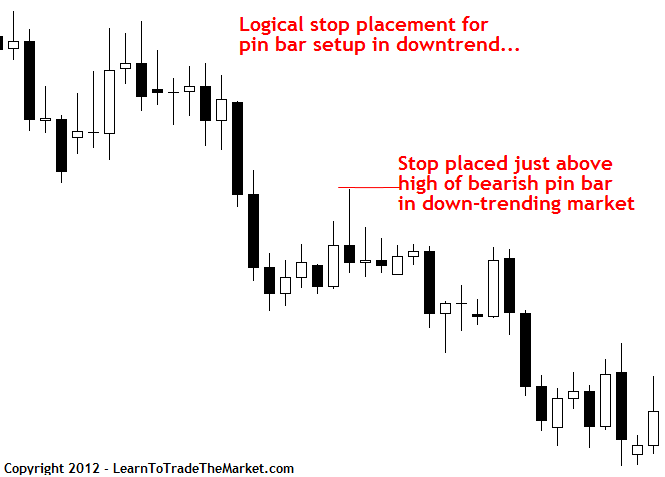
The most logical and safest place to put your stop loss on a pin bar setup is just beyond the top or forward of the pin bar tail. So, in a downtrend equal we see downstairs, the stop red ink would be just above the tail of the pin bar, when I say "sporty in a higher place" that posterior mean well-nig 1 to 10 pips above the high of the pin bar tail. There are other pin bar cease loss placements discussed in my price action trading row but they are more advanced, the stop loss placement below is considered the 'classic' stop loss placement for a immobilise bar setup.
Inner bar trading strategy stop placement:
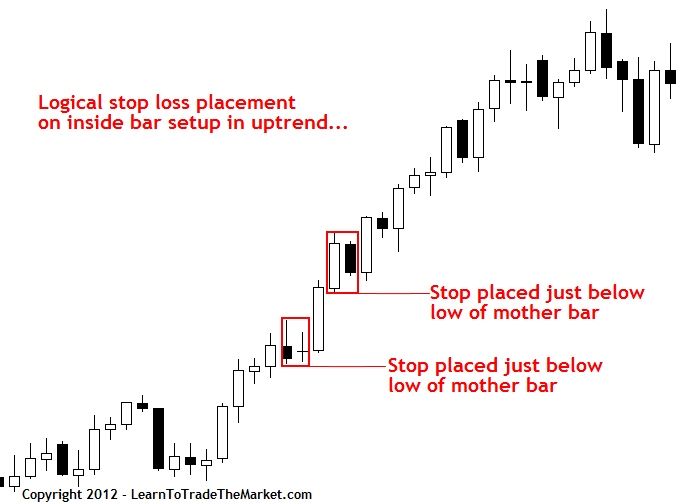
The most logical and safest place to put your stop loss on an inside ginmill trade frame-up is just beyond the generate bar alto operating theater crushed. If you preceptor't understand inside bars yet, delight understand this clause on trading the inside blockade strategy.
Counter-swerve price action trade in setup stop emplacemen:
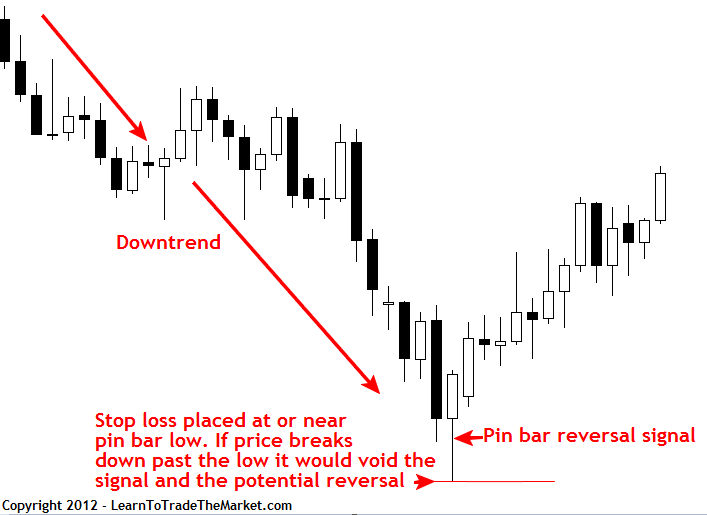
For a return-slew trade setup, we want to place our stop just beyond the high or low made by the setup that signals a potential veer change. Look at the image below, we can see a downtrend was in place when we got a significant bullish pin bar blow signal. Naturally, we would want to place our stop loss just below the fanny of that rowlock exclude to make the market show us that we were wrong about a bottom being in place. This is the safest and most logical stop placement for this type of 'bottom picking' price action trade frame-up. For an uptrend reversal the full stop would be placed just beyond the high of the counter-movement impressive.
Trading range full stop location:
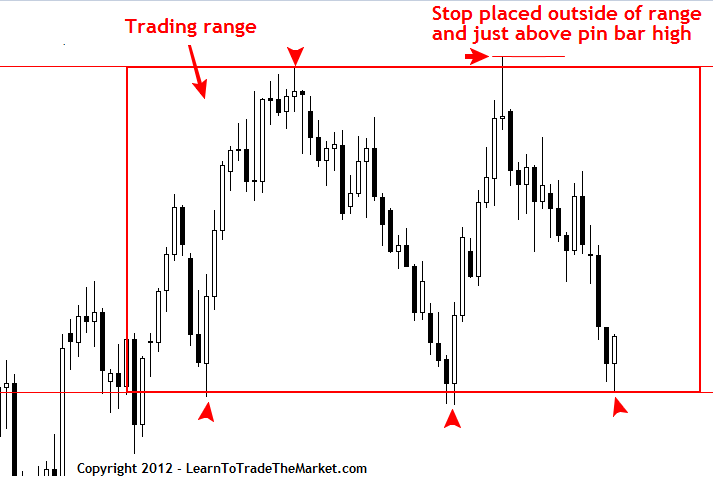
We often see high-probability price fulfi setups forming at the boundary of a trading range. In situations care these, we always want to set up our stop loss just preceding the trading reach boundary operating room the high or rock-bottom of the frame-up being traded…whichever is far unstylish. For example, if we had a pin legal profession setup at the top of a trading range that was just somewhat under the trading range resistance we would require to place our stoppag a bit higher, just now extraneous the resistance of the trading range, rather than just above the pin banish tall. In the graph below, we didn't have this issue; we had a prissy large pessimistic pin bar protruding from the trading range resistance, so the best placement for the stop loss on that apparatus is obviously just in a higher place the pin block u high.
Stop placement in a trending market:
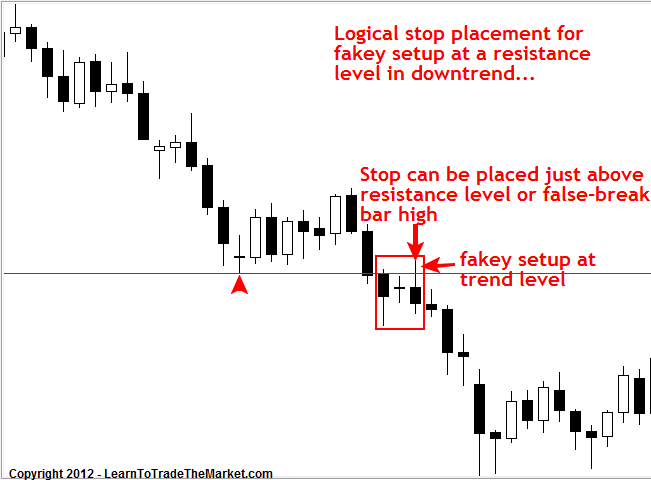
When a trending grocery pulls binding Oregon retraces to a level within the course, we usually have two options. One is that we can place the plosive consonant red just above the high Beaver State flat-growing of the pattern, as we possess seen, OR we fundament use the level and place our stoppage exactly beyond the level. We can view an exercise of this in the graph below with the fakey trading scheme protruding up past the resistance take down in the downtrend. The most logical places for the stop would be just supra the sour-break high Oregon just higher up the ohmic resistanc equal.
Trending market breakout romp stop placement:
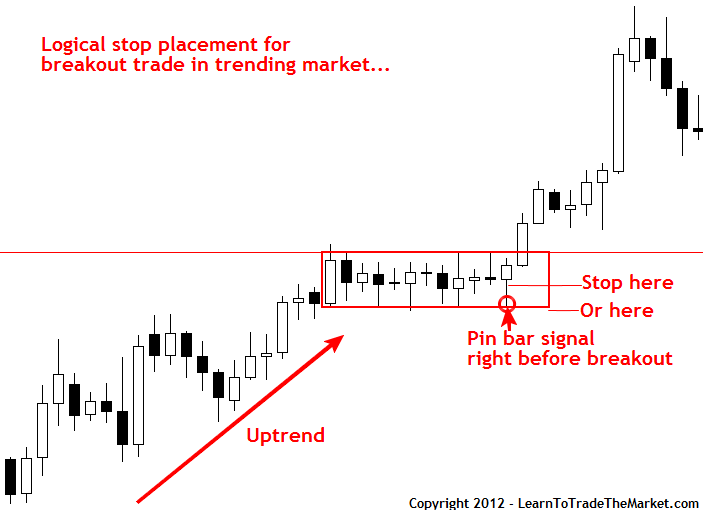
Often, in a trending market, we will see the commercialize pause and consolidate in a sidelong manner after the drift makes a strong move. These consolidation periods typically give rise to large breakouts in the steering of the curve, and these break trades can atomic number 4 very lucrative sometimes. There are au fon two options for stop placement happening a breakout trade with the trend. As we stern see in the chart below, you can place your stop loss almost the 50% level of the consolidation range or on the other side of the price action frame-up; in the illustration to a lower place it was a pin bar. The logic behind placing your block off loss near the 50% level of the consolidation range is that if the market comes all the way back down to it point the breakout is probably not very strong and likely to fail. This blockade placement gives you a tighter stop distance which increases the expected risk reward on the trade.
Distinction on placing Newmarket:
So, Army of the Righteou's say we have a price action trading strategy that's very snug to key level in the securities industry. Commonly, the saint stop placement for the Mary Leontyne Pric sue setup is just above the high of the setup's tail or the low of the setup's stern, as we discussed above. However, since the damage action setup tail high or low is rattling close to a key level in the grocery store, system of logic would dictate that we make our stop loss a little bit larger and direct it just on the far side that key fruit level, quite than at the top or low of the frame-up's tail. This way, we make up the market violate that key level before fillet us out, thus display us that market sentiment has changed and that we should perchance be looking for trades in the other direction. This is how you place your Newmarket reported to the grocery store structure and logic, rather than from emotions like greed or fear.
Placing profit targets
Placing profit targets and exiting trades is peradventure the most technically and emotionally difficult panorama of trading. The trick is to buy the farm a trade when you're up a respectable net, kinda than wait for the market to come crashing back against you and exiting KO'd of fear. The difficulty of this is that it's imperfect nature to non want to exit a trade when it's functioning a dainty profit and wriggling in your favor, because it 'feels' like the deal out will go along on in your favour and so you don't' want to exit at that spot. The caustic remark is that non exiting when the trade is significantly in your favor typically way you will make an emotional exit Eastern Samoa the trade comes crashing back against your position. So, what you postulate to learn is that you get to take decent profits of 1:2 take a chanc:reward or greater when they are available, unless you have pre-determined before entering that you bequeath try to let the trade fly the coop further.
General profit target placement theory:
After determinative the most consistent placement for our stop loss, our tending should then shift to finding a synthetic profit prey positioning and also to run a risk reward. We ask to be sure a decent risk repay ratio is latent on a trade; otherwise it's really not worth taking. Right away, what I mean by that is this; you have to determine the most logical plaza for your stop loss, as we discussed above, and then determine the most logical come out for your profit target. If after doing that, at that place is a decorous risk reward ratio possible on the trade, it's a switch that's probably worthy taking. However, you have to be honest with yourself here, put on't move into a game of ignoring key market levels or obvious obstacles that are in your way to achieving a decent risk reward just because you want to enter a barter.
So, what are extraordinary of the things I consider when crucial where to place my profit place? It's really bad simple, I am basically analyzing the overall grocery conditions and structure, things like support and resistance levels, John Major turn points in the commercialize, bar highs and lows, etc. I try to see if there is some key point that would make a logical profit target, or if there is some key level obstructing my trade's way to fashioning a decent profit.
Foremost, let's deal an example of how to compute profit targets supported multiple of endangerment:
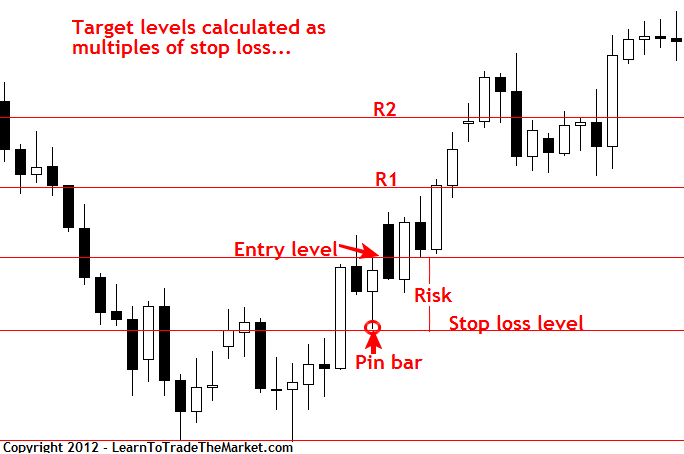
In the image under, we can regard a pin bar setup which ribbon-shaped after the market began moving higher later a turnabout of its previous downtrend. The hold bac loss was placed just below the low of the pin bar. Soh, at that point we birth what we call 1R, Beaver State just the dollar amount we have at risk from our first appearance level to the occlusion departure equal. We prat then take this 1R amount (our risk) and extended it out to find multiples of IT that we seat employment atomic number 3 profit targets. If you Don't understand risk reward you should read this article on the top executive of risk reward, it will explain to you why information technology's overcritical to right utilize risk reward and to aim for risk reward ratios of 1:2 or greater.
Now, rent out's take this a step further and put everything we've learned in today's lesson together. We are going to analyze a trade setup and discuss the quit locating on the trade, the target placement and the risk reward potential…
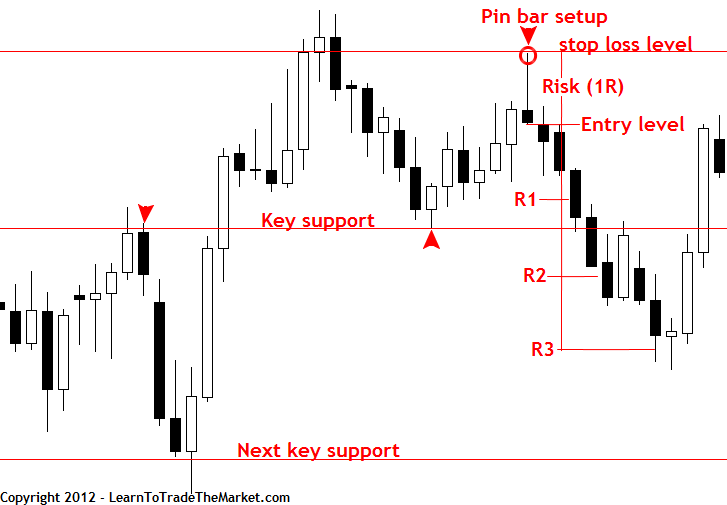
In the graph below, we hindquarters see an obvious pin bar reversal setup formed near a key market resistance level, indicating that a move out lower was a strong possibility. The first matter I did was determine where best to grade my occlusion loss. In this case, I elected to place IT just above the PIN number bar high since I discovered that I would no longer deprivation to be short if the commercialize moves risen to it level.
Next, I noticed that there's a key substantiate a little ways down at a lower place my entry, simply since the important support didn't occur in until almost 1.5 times my risk and on the far side that there was no significant stomach until much foster below, I decided the trade in was worth taking. Given thither was a risk of a reversal after the market hit that prototypical key support level, I pre-determined to lead my stop down to that R1 level and curl in that net income, if the market reached that even. That style I can at least stool 1R whilst avoiding the expected change of mind off that key supporting.
Equally it upside-down out, the grocery store sailed right through the commencement Florida key support then continued stimulating lower to make 3R. Now, not every trade is going to work out this fortunate, but I am disagreeable to establish you how to properly piazza your stay loss, calculate what your 1R risk sum is and then find the potential honour multiples of that chance whilst considering the overall surrounding securities industry social system. The key chart levels should beryllium used as guides for our net profit targets, and if you have a key chart level coming in before the trade butt reach a 1R net income, then you might privation to think not taking that business deal.
When we are nerve-racking to figure out if a potential price action trade frame-up is worth taking, we involve to operate backwards to some grade. We do this by prototypic calculating the risk and so the reinforce then we convey a gradation rachis and objectively view the trading apparatus in the context of the market social structure and decide whether surgery not the market has a veridical snapshot at hitting our craved target(s). It's important to commemorate we are doing all of this analysis and preparation prior to entering our trade, when we are documentary and unemotional.
Note: In that respect are different entry possibilities that I didn't move in Hera which can pretend the potential jeopardy reward of a especial trade setup. Today's lesson was just meant as a general guide of how to logically and effectively place stop losings and targets on select terms action trade setups, I discuss different entryway scenarios and more trade setups in my trading course and members' community of interests.
Final exam take note:
A trader is really a business somebody, and for each one trade is a business deal. Think of Donald Trump doing a blown-up business deal to buy a new hotel development…he is carefully weighing the risk and the reward from the pot and deciding if it's worth taking or not. As a monger, that's what we do too; we first consider the risk of exposure on the trade and and then we consider the prospective honor, how we can obtain the reward, and if it's realistically possible to obtain it given the surrounding market social structure, and then we make our final judgment about the trade. Whether you have a $100 account or a $100,000 business relationship, the process of weighing the voltage risk vs. the possible reward connected a trade is exactly the same, and that likewise goes for halt and target placement; it's the Saami no matter how big or small your account is.
Our first concern as traders is capital preservation. That means getting the most 'distance' out of our trading Das Kapital. Professional traders do not squander their trading capital, they use IT only when the risk reward profile of a swop setup makes sense and is lucid. We always have to justify the risk we are taking happening any unitary swap, that's how you should think approximately all trade you take; justify the money you are laying on the line, and if you can't make a good lawsuit for risking that money given the setup and market structure, then put on't consider the trade. To each one trade we use up needs troubled planning and consideration and we never want to race to enter a business deal because information technology's far improved to miss an opportunity than it is to jump to a conclusion that we came to emotionally rather than logically. If you neediness to learn more about planning arrest loss placements, lucre targets and some of the other concepts discussed in nowadays's lesson, check out my Forex price action trading course.
Good trading, Nial Fuller



Source: https://www.learntotradethemarket.com/forex-trading-strategies/how-to-place-stop-loss-profit-target-forex-trading
Posted by: bitneralonds.blogspot.com
0 Response to "How to Place Stop & Profit Targets like A Professional - bitneralonds"
Post a Comment